Research: China PIPL and U.S. PADFAA / DOJ DSP compliance
Disclaimer: This document is not legal advice and does not constitute legal recommendations. Any implementation or compliance program informed by it must be reviewed and approved by your organization’s internal corporate legal team (or equivalent qualified counsel).
An appendix defines roles for Legal, Compliance/Security, and Engineering and clarifies workflow boundaries in general compliance operations.
US: PADFAA and DOJ DSP
Background
Following EO 14117, Congress enacted the Protecting Americans’ Data from Foreign Adversaries Act (PADFA / PADFAA) and the DOJ issued the Data Security Program (DSP) to curb national-security risks from foreign access to Americans’ sensitive data. PADFA forbids data brokers from making personally identifiable sensitive data available to foreign adversary countries (China, Russia, Iran, North Korea) or their controlled entities, enforced by the FTC with civil penalties. DOJ’s DSP, binding on U.S. persons, prohibits or conditions covered data transactions that grant countries of concern (China, including Hong Kong/Macau, Russia, Iran, North Korea, Cuba, Venezuela) access to bulk sensitive personal or government-related data, requiring CISA-aligned controls and reporting, with IEEPA civil and criminal penalties. Together, PADFA targets the data-broker market; DSP governs broader transactional access.
PADFA was signed on April 24, 2024, and took effect 60 days later (June 23, 2024). The DOJ DSP took effect on April 8, 2025. DOJ announced a 90-day implementation/enforcement policy through July 8, 2025; after that window, DOJ began pursuing enforcement. Certain affirmative obligations (for example due diligence, audit, and reporting for restricted transactions) begin October 6, 2025.
Executive summary — PADFAA and DOJ DSP
PADFAA and the DOJ DSP set new compliance obligations for handling sensitive U.S. personal data. The rules restrict or prohibit transactions involving foreign adversaries and require organizations to audit, document, and monitor data flows.
Key measures include strong vendor due diligence, data-flow mapping, secure record-keeping, and adherence to internal security policies. Organizations must align practices with regulatory requirements, train staff, and prepare for enforcement.
Baseline reviews can produce broad or generic output; a structured, context-aware compliance approach reduces noise and keeps risk management actionable.
Failure to comply may result in significant civil or criminal penalties—proactive governance and cross-team coordination matter.
Legal interpretation (pending legal review)
1. Targeted counterparties (whom you must not give access to)
| Dimension | PADFA | DOJ DSP |
|---|---|---|
| Foreign adversary / countries of concern | China, Russia, Iran, North Korea | China (incl. Hong Kong/Macau), Russia, Iran, North Korea, Cuba, Venezuela |
| Affiliated entities / actors | Entities “controlled by” a foreign adversary (e.g. ≥20% ownership or other control) | Covered persons (organized in, owned/controlled by, or acting on behalf of the above) |
2. Regulated actors (who the rules bind)
| Regime | Who is bound |
|---|---|
| PADFA | Data brokers — entities that make data available for value without collecting it directly from the individual |
| DOJ DSP | U.S. persons engaging in covered data transactions |
3. Covered data types (what data is in scope)
- Overlapping sensitive personal data (both): precise geolocation; health; biometric/genetic; financial; government IDs; private communications; minors’ data; protected-class attributes; device-linkable identifiers.
- DOJ DSP additions: bulk sensitive personal data (volume threshold), U.S. government-related data, human ’omic data and biospecimens, telecom/metadata indicators.
4. Corresponding operations (what is barred or conditioned)
Prohibited
- PADFA: Data brokers may not sell, license, rent, trade, transfer, disclose, provide access to, or otherwise make covered data available to foreign adversaries or their controlled entities.
- DOJ DSP:
- Data-brokerage that gives countries of concern / covered persons access to bulk sensitive personal or government-related data.
- Any transaction granting those actors access to bulk U.S. human ’omic data or biospecimens.
Restricted / conditional (DOJ DSP only)
Vendor/supply, employment, investment, and specified cloud/IT transactions with countries-of-concern counterparties are allowed only if robust CISA-aligned security controls, due diligence/audits, recordkeeping, and reporting are implemented (anti-evasion rules apply).
China: PIPL
Background
China’s Personal Information Protection Law (PIPL) took effect on November 1, 2021. It is a comprehensive privacy statute with extraterritorial reach, regulating personal information processors (controller-like entities) that handle data of individuals in China, including from abroad. PIPL distinguishes personal information (PI) from sensitive PI and excludes anonymized data.
Executive summary — PIPL and PIPIA
PIPL establishes a GDPR-style framework with lawful basis (often consent), purpose limitation, data minimization, transparency, and security measures (such as encryption).
High-risk activities—processing sensitive PI, automated decision-making, or cross-border transfers—require a Personal Information Protection Impact Assessment (PIPIA). Overseas processors may need a local representative and must use an approved outbound transfer mechanism (CAC security assessment, certification, or standard contracts), with localization obligations for CIIOs and some large processors. Individuals have rights including access, rectification, deletion, objection/restriction, portability, and withdrawal of consent; the child threshold is 14. Enforcement by the CAC includes rectification/suspension orders and fines up to RMB 50 million or 5% of prior-year turnover, plus personal liability.
Compared to GDPR, PIPL places greater emphasis on consent, sets the child age at 14 (versus GDPR’s default of 16), and explicitly excludes anonymized data. Unlike the DOJ DSP—a national-security rule that prohibits or conditions transfers to countries of concern—PIPL is a general, cross-sector privacy law governing in-scope processing and exports.
PADFAA / DOJ DSP compliance requirements (pending legal review)
- Covered data types: Sensitive U.S. personal data includes biometric, geolocation, financial, health, and government-related information. Both PADFAA and DSP define covered data transactions involving these categories.
- Foreign adversaries and covered persons: Transactions involving entities linked to foreign adversaries (China, Russia, Iran, North Korea) or entities controlled by them fall under PADFAA restrictions.
- Prohibited vs restricted: Some transactions are forbidden; others are permitted only as restricted transactions under DOJ DSP rules.
- Data-flow auditing and mapping: Map flows, especially cross-border, to identify adversary-controlled exposure; audit regularly.
- Record-keeping and reporting: Maintain records of transactions, vendor contracts, and controls; report prohibited/restricted transactions and violations as required.
- Vendor and third-party due diligence: Contracts must support PADFAA/DSP requirements; third parties share responsibility for secure handling.
- Enforcement and penalties: Grace periods have applied (e.g. 90 days from effective dates); violations can carry significant civil or criminal penalties, including fines per incident.
- Internal policies and training: Align security policies with PADFAA/DSP; train staff; document efforts.
Vendor due diligence checklist (example)
1. Vendor identity and ownership
- Have we verified the vendor’s legal name, country of incorporation, and ownership structure?
- Is the vendor free from ties to foreign adversaries (China, Russia, Iran, North Korea)?
- Have we screened for sanctions, export-control lists, or restricted entities?
2. Data handling and security
- Does the vendor process, transmit, or store sensitive U.S. personal data?
- Are encryption, access controls, and logging in place for data in transit and at rest?
- Does the vendor have SOC 2, ISO 27001, FedRAMP, or equivalent certifications?
- Have we reviewed how the vendor handles data deletion and retention policies?
3. Compliance and contracts
- Does the vendor agree to comply with PADFAA, DOJ DSP, and applicable privacy laws (e.g. GDPR, CCPA, PIPL)?
- Are contractual clauses in place for data security, reporting obligations, and breach notifications?
- Do we retain audit rights to assess vendor compliance?
4. Risk management and monitoring
- Have we conducted a security risk assessment of the vendor?
- Are there procedures for ongoing monitoring and reassessment (e.g. annual reviews)?
- Is the vendor required to disclose subcontractors or downstream service providers?
5. Incident response and continuity
- Does the vendor have a documented incident response plan?
- Are they required to notify us within a set timeframe if an incident occurs?
- Do they have a business continuity or disaster recovery plan in place?
Appendix: Compliance workflow
The expected roles and workflow are summarized below (conceptual, not org-chart specific).
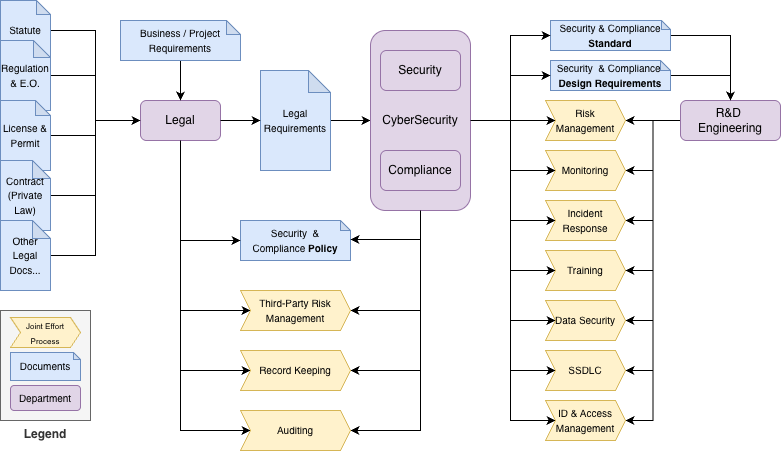
Legal–engineering perspective
Legal perspective. “In compliance” means conforming to all binding obligations: statutes and regulations, licenses and permits, regulatory orders, court judgments, and relevant contracts. Obligations vary by jurisdiction and change over time—compliance is scope-specific and continuous, not a one-time event. Organizations demonstrate compliance through a risk-based program that prevents, detects, and remediates violations.
Engineering perspective. After Legal interprets the rules, compliance/engineering translates them into policies, processes, and controls, embeds them into systems (“compliant-by-design”), and produces evidence of design effectiveness (sensible and implemented) and operating effectiveness (runs reliably).
Roles across compliance operations
Summary
Effective compliance is a relay: Legal defines what the law requires; Security/Compliance defines how to meet it and runs organizational/process controls; Development embeds controls and produces evidence they exist and work. The outcome is demonstrable design and operating effectiveness across compliance categories.
Legal (interpret and define requirements)
- Governance and accountability: Interpret applicable laws/regs; maintain a requirements register; assign policy owners and approval paths.
- Third-party and contracts: Draft/negotiate clauses (IP, data, audit, export), sanctions/anti-boycott language.
- Policy management: Approve policies/standards; set exceptions and risk-acceptance criteria.
- Process and records: Define legal bases, retention/destruction, cross-border rules; advise on incident notification triggers.
- Audit and assurance: Advise on regulator interactions, investigations, subpoenas, and certification scopes.
Security / Compliance (translate and operationalize)
- Program and governance: Convert legal obligations into controls, owners, and KPIs/KRIs; run the compliance calendar.
- Policy and process: Author policies/SOPs; data lifecycle practices (classification, ACLs, retention, transfer controls).
- Data security: Encryption, key management, tokenization, DLP, discovery/mapping, segregation.
- Secure SDLC and change: Gating (threat modeling, SBOM, code review, IaC/policy-as-code), SoD, change approvals.
- Training and awareness: Role-based training and completion tracking.
- Controls and risk: Preventive/detective/corrective controls; risk assessments and vulnerability management with remediation.
- Incidents: IR playbooks, investigations, regulator/customer notifications.
- Monitoring and evidence: Continuous control monitoring; evidence repositories and metrics; internal/external audits to closure.
Development (implement and evidence)
- Built-in controls: Least-privilege IAM, logging, encryption in transit/at rest, minimization, segregation within services.
- SDLC execution: Secure coding, dependency/SBOM hygiene, CI policy checks, IaC guardrails; document design decisions.
- Data and process: Classification and retention in schemas/jobs; lawful-basis and consent flows where applicable; control data exports.
- Evidence generation: Auditable artifacts (PRs, test results, pipeline logs, config snapshots, access reviews, tickets).
- Operational readiness: Current runbooks; support IR and audits with reproducible queries and exports.
Conclusion (workflow)
When Legal’s “what” maps traceably to Security/Compliance’s “how” and Development’s “build and prove,” the organization can show its work: the control, the owner, and the evidence—on demand. That is the practical definition of complying and a reliable way to reduce regulatory, contractual, and operational risk.
Supplement: Protecting Americans’ Data from Foreign Adversaries Act of 2024 (PADFA)
Executive summary
PADFA prohibits data brokers from making personally identifiable sensitive data of U.S. individuals available to foreign adversary countries—China, Russia, Iran, and North Korea—or to entities controlled by such countries (including ≥20% ownership or other forms of control). The FTC enforces PADFA as a rule under the FTC Act, with civil penalties under 15 U.S.C. § 45(m)(1)(A). The law took effect 60 days after enactment (June 23, 2024). Challenges to the division are heard exclusively in the D.C. Circuit within specified time limits. (Sources: Federal Trade Commission, Congress.gov.)
Background and purpose
Congress enacted PADFA (Division I of Public Law 118-50) amid concern that data-broker markets enable bulk transfers of Americans’ sensitive data to foreign adversaries, posing national-security and privacy risks. PADFA establishes a bright-line federal prohibition on such transfers to specified countries or their controlled entities and routes enforcement through the FTC’s existing framework. (Congress.gov.)
Effective date
PADFA’s prohibition became effective 60 days after enactment—June 23, 2024. (Congress.gov.)
Regulatory overview
- Core prohibition: A data broker may not “sell, license, rent, trade, transfer, release, disclose, provide access to, or otherwise make available” covered data to a foreign adversary country or a controlled entity. (Congress.gov.)
- Who is covered: “Data broker” includes entities that, for valuable consideration, make available data they did not collect directly from the individual to a third party (with enumerated exclusions). “Controlled by a foreign adversary” includes domicile/organization, ≥20% ownership, or direction/control. (Congress.gov.)
- What data is covered: “Personally identifiable sensitive data” identifies or is reasonably linkable to an individual or device; “sensitive data” spans government IDs, health, financial, biometrics, genetic data, precise geolocation, private communications, minors’ data, protected-class information, among others. (Congress.gov.)
- Foreign adversary countries: PADFA incorporates 10 U.S.C. § 4872(d)(2): China, Russia, Iran, North Korea. (Legal Information Institute.)
- Judicial review: Challenges lie exclusively in the U.S. Court of Appeals for the D.C. Circuit, subject to 165-day (facial) and 90-day (action-specific) filing windows. (Congress.gov.)
Enforcement
PADFA violations are enforced by the FTC as violations of an FTC rule under Section 18 of the FTC Act; the Commission may use its full suite of remedies. (Congress.gov.)
Penalties
Civil penalties are available under 15 U.S.C. § 45(m)(1)(A). The FTC’s inflation-adjusted maximum was $53,088 per violation (as of 2025) and is adjusted annually. (Federal Trade Commission.)
References (PADFA)
- Public Law 118-50 (H.R. 815), Division I—Protecting Americans’ Data from Foreign Adversaries Act of 2024 (statutory text; definitions; FTC enforcement; effective date). (Congress.gov.)
- Congress.gov bill page for H.R. 815 (division summaries; judicial-review venue and time limits).
- 10 U.S.C. § 4872(d)(2) (foreign adversary countries incorporated by reference).
- FTC—inflation-adjusted civil penalty amounts (2025).
- Selected practitioner summaries on PADFA scope and data categories (secondary). (Akin.)
Supplement: Department of Justice Data Security Program (DSP)
Executive summary
The DOJ’s DSP, codified at 28 C.F.R. Part 202, functions like export controls on data. It (i) prohibits U.S. persons from certain data-brokerage transactions and any human ’omic / biospecimen transfers that would give countries of concern (China, Cuba, Iran, North Korea, Russia, Venezuela) or their covered persons access to bulk U.S. sensitive personal or U.S. government-related data; (ii) restricts specified vendor, employment, and investment agreements unless stringent CISA-aligned security requirements are met; and (iii) imposes due diligence, audit, recordkeeping, and reporting on restricted transactions. The rule took effect April 8, 2025, with a 90-day enforcement policy through July 8, 2025, and certain audit/reporting obligations from October 6, 2025. Civil penalties can reach the greater of $368,136 per violation or 2× the transaction value; willful violations may carry criminal penalties (up to 20 years and $1,000,000).
Background and purpose
The DSP implements Executive Order 14117 to mitigate national-security risks from commercial access to Americans’ bulk sensitive personal and government-related data by countries of concern and their covered persons.
Effective date
Final rule published January 8, 2025; effective April 8, 2025. DOJ’s 90-day implementation/enforcement policy through July 8, 2025; certain due diligence, audit, and reporting from October 6, 2025.
Regulatory overview
- Prohibited transactions (Subpart C): (a) Data-brokerage with any country of concern/covered person; (b) other data-brokerage with onward-transfer risks; (c) transactions granting access to bulk U.S. human omic data or biospecimens. Anti-evasion and “knowingly directing” prohibitions apply.
- Restricted transactions (Subpart D): Vendor, employment, and investment agreements allowed only if the U.S. person meets incorporated CISA Security Requirements (minimization, de-identification, encryption, PETs, etc.).
- Licensing, opinions, exemptions: General/specific licenses, advisory opinions, exempt classes (e.g. personal communications, informational materials, certain regulatory submissions).
Enforcement
DOJ (National Security Division) enforces under IEEPA, with 10-year recordkeeping, annual reports for certain cloud restricted transactions, and 14-day reports on rejected prohibited data-brokerage offers.
Penalties
Civil penalties: greater of $368,136 or twice the transaction value per violation. Willful violations: up to 20 years imprisonment and $1,000,000 fine.
References (DSP and related)
- PADFAA — practitioner updates (e.g. Carter Ledyard & Milburn LLP, Honigman, Baker McKenzie, Akin); treat as secondary unless your counsel endorses a specific memo.
- DOJ press materials: National Security Program for sensitive data; Implementation & Enforcement Policy (Apr. 11, 2025); FAQs; Compliance Guide (PDF).
- Federal Register — final rule (Jan. 8, 2025): preventing access to U.S. sensitive data by countries of concern.
- eCFR — 28 C.F.R. Part 202 (definitions; prohibited/restricted transactions; reporting; penalties; effective date).
- Secondary industry alerts (e.g. Proskauer, White & Case) on enforcement timing and penalty levels—use as non-primary context only.
Research notes only—see the disclaimer above.