A systematic approach to product security
Summary
Product security is operational discipline embedded in how products are designed, built, shipped, and run. Two anchors make that discipline durable: shift-left security (find and fix issues before they become expensive incidents) and secure design (build controls into the architecture instead of bolting them on later).
This note lays out a systematic way to run the work: classify risk in ways that match how engineering actually spends time, connect each risk class to established security practices, prioritize tasks along importance and urgency, and measure whether the program is broadening coverage and deepening defenses—without sliding backward when schedules tighten.
Definitions: threat, vulnerability, and risk
Threat, vulnerability, and risk are not interchangeable labels; each answers a different question. Even so, all three describe conditions that can lead to harm, service disruption, or unexpected loss.
The NIST glossary offers concise anchors:
- A vulnerability is a weakness that could be exploited.
- A security risk is the effect of uncertainty on objectives—often expressed in terms of likelihood and impact on assets.
- A threat is a circumstance or event with the potential to cause adverse impact.
For the rest of this article, risk is used as the umbrella term when the distinction between threat, vulnerability, and composite risk does not change the recommended action. When a control decision depends on the difference (for example, “patch a defect” vs “monitor a motivated adversary”), use the precise word.
Core responsibilities
The product security function exists to protect products and services from material harm—confidentiality, integrity, and availability failures, safety issues where applicable, and unacceptable business impact. In practice, that means:
- Discovering risk through design review, testing, telemetry, and intelligence
- Mitigating risk with engineering changes, configuration hardening, and compensating controls
- Eliminating risk where that is feasible (for example, removing an unnecessary feature or dependency)
- Making residual risk explicit so owners can accept, transfer, or fund further work
Day to day, product security partners with the teams that actually change systems. The diagram below is a compact map of how product security, DevOps, DevSecOps, and information security (InfoSec) commonly align: product security leans toward the application and SDLC; DevSecOps leans toward runtime and platform posture; InfoSec often anchors enterprise policy, identity, and data protection expectations that customer-facing services must meet.
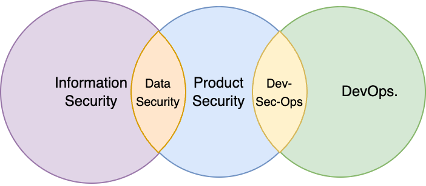
Typical collaboration patterns include:
- With DevOps / platform engineering: shared ownership of deployment pipelines, secrets handling, and production configuration drift
- With DevSecOps: continuous monitoring, guardrails in CI/CD, and baseline hardening that keeps pace with releases
- With InfoSec: enterprise security standards, customer data protection requirements, and incident coordination across product lines
Why a systematic approach matters
Security work is non-deterministic: you cannot schedule every defect, and you cannot predict every external attack. What you can control is process quality—repeatable methods that improve posture over time and make regressions visible early.
A systematic program rests on three commitments:
- Visibility: maintain an inventory of risks and security tasks large enough to steer staffing and roadmaps
- Leverage: prefer durable fixes and preventive controls over one-off firefighting when trade space allows
- Non-regression: raise baselines as the product evolves; “we fixed it once” is not the same as “we made the class of failure unlikely to return”
Recognize risk and security work
Risk categories by project phase
Risks are not evenly distributed across the lifecycle. A practical program maps where risk shows up so engineers spend time on the highest-leverage phase for each issue.
| Phase | Risk category | What it is | Why it matters |
|---|---|---|---|
| Released / production | Existing risk | Weaknesses already present in live systems—often rooted in design tradeoffs, incomplete hardening, or latent implementation bugs | Remediation is expensive; changes require careful rollout and may affect customers directly |
| Active development | Potential risk | Issues not yet in production—requirements gaps, fragile design, or implementation mistakes still in review | The cheapest window to correct course; this is where SSDLC activities earn their return |
| All projects | Future risk | Events you cannot fully predict—zero-day issues in dependencies, novel attack chains, or insider scenarios | Requires preparedness: monitoring, patching discipline, IR readiness, and architectural resilience |
Risk categories by knowledge state
The “known / unknown” framing is a planning tool. It tells you what kind of evidence you need next: documentation, review, scanning, testing, threat intelligence, or red teaming.
| Knowledge state | Meaning | Example |
|---|---|---|
| Known-known | Facts you have validated | Security requirements are documented, tested, and signed off for a release |
| Known-unknown | You know the question; evidence is incomplete | “Our auth flow is complex—reviewers have not yet walked every edge case.” |
| Unknown-known | Information exists, but the organization has not internalized it | A scanner reports a dependency issue that no owner has triaged into a backlog item |
| Unknown-unknown | Blind spots nobody has named yet | A novel failure mode in a new integration surfaced only after an incident |
Combined view: knowledge × lifecycle phase
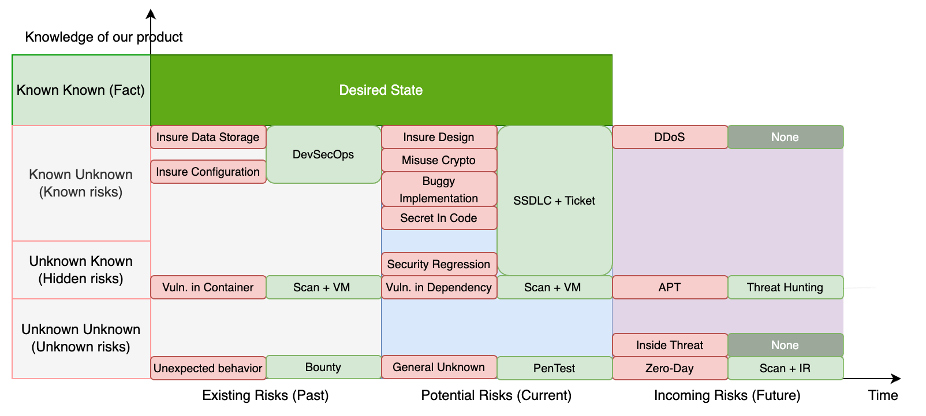
The matrix below is a planning aid, not a taxonomy you must defend in a meeting. Use it to ask: given what we know today, which countermeasures are proportionate for production vs development vs enterprise-wide readiness?
| Knowledge state | Existing risk (production) | Potential risk (development) | Future risk (all projects) |
|---|---|---|---|
| Known-known | Target desired state; measure compliance to baselines | Prefer prevention: standards, training, and automated checks early | Fund resilience and monitoring for assumptions you have validated |
| Known-unknown | Configuration weaknesses, weak key hygiene, partial logging | Flawed design, incomplete input validation, inconsistent authorization | Commodity attacks such as DDoS where playbooks exist but tuning is incomplete |
| Unknown-known | Latent issues in images or services not tracked to owners | Secrets or keys embedded in repos; dependencies nobody claims | APT-style threats where intelligence exists externally but is not operationalized internally |
| Unknown-unknown | Unexpected emergent behavior under load or failover | Misuse of crypto APIs, token handling mistakes, unsafe defaults | Zero-day vulnerabilities and insider threats with limited prior signal |
The next figure maps knowledge states to representative security tasks—useful when building a quarterly plan or explaining why you need more than one type of assessment.
Security practice areas: discovery and countermeasures
Mature teams do not rely on a single activity. They assemble complementary practices—each catches different classes of issues at different costs.
Core engineering practices
- Secure SDLC (SSDLC)
- Architecture and design review
- Threat modeling
- Security-focused code review
- Security testing (SAST/DAST/IAST as appropriate, plus manual testing)
-
Incident response planning tied to the service’s real dependencies and data flows
-
Penetration testing — adversarial validation of production-like environments and critical paths
-
CI/CD security scanning — fast feedback on dependencies, secrets, IaC, and container images
-
Vulnerability management — intake, prioritization, SLA tracking, and exception handling with owners
-
Security consultation / ticketing — unblock developers on threat modeling questions, data classification, crypto choices, and prototype reviews
-
Incident response — practiced execution when controls fail
Platform and operational practices
- DevSecOps
- Configuration management and drift detection
- Key and secret lifecycle management
- Network and identity controls (including ACLs and least privilege)
External signal
- Bug bounty programs — scalable review for externally reachable attack surface, with clear scope and safe harbor
Adjacent disciplines (often shared with InfoSec)
- Threat hunting — hypothesis-driven search for adversary behavior in telemetry
- Data security — classification, access governance, and encryption strategy
- Security auditing — evidence collection for internal policy and external assurance
Putting the system to work
Two-dimensional prioritization (importance × urgency)
Shift-left work is important because it prevents recurring classes of defects. Incident response and active exploitation are urgent because they threaten customers now.
SSDLC is the backbone of shift-left execution—but it does not remove the need for responsive operations. Effective teams manage the tension deliberately. For a deeper treatment of macro prioritization patterns, see Security tasks and prioritization.
Evaluate work on both axes:
- Importance — durable reduction of risk across releases (architecture, standards, training, automation)
- Urgency — time sensitivity driven by exposure, exploitability, or active threat
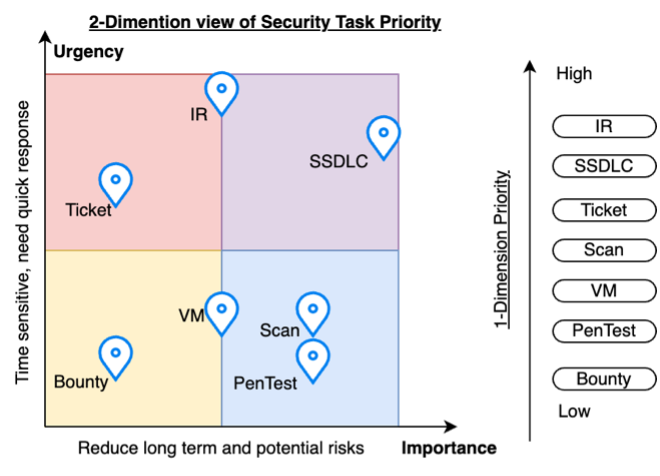
Working copy in this repo: docs/assets/security-musings/2d-map.png (source: materials/2d-map.png).
Prevent security regression
Continuous improvement fails if every release reintroduces the same failure modes. Regression resistance comes from systems, not heroics:
- Treat incidents and near misses as classes, not singletons. When you fix an issue, budget time to hunt for siblings (shared libraries, copy-paste endpoints, parallel deployments).
- Publish how you work. Maintain process documentation and lightweight templates so reviews collect the same facts each time; improve the templates when lessons land.
- Publish how to build safely. Keep technical guidance close to the ticket queue—short, current notes beat a shelf of stale PDFs.
- Automate baselines where automation is accurate enough to trust: dependency updates, policy checks, and deployment gates that match the team’s risk appetite.
- Raise standards on a schedule. Security expectations should advance with the product; policy without enforcement becomes theater.
Measurement: coverage and depth
Effectiveness is not “number of tickets closed.” It is risk reduced relative to what you ship and what you run. Two complementary lenses help:
Horizontal coverage — how many projects or services are in scope?
Prioritize breadth using business impact and data sensitivity, not convenience. A portfolio view prevents the common failure mode where only the “friendly” teams receive reviews.
Vertical depth — how strong are the controls in each critical system?
Depth spans layers such as:
- Build and delivery security — pipeline integrity, artifact provenance, and safe deployment practices
- Runtime and data protection — encryption, access control, logging, and detection
- Resilience — backup, recovery, and practiced incident response
Portfolio mapping should be honest about residual risk. The goal is informed ownership, not a green dashboard.
Conclusion and recommendations
A systematic product security program connects risk clarity to repeatable execution. If you are standing up or refining a program, the following actions are high leverage:
- Institutionalize SSDLC for in-flight development. Use templates for design artifacts and review records so decisions are traceable and comparable across teams.
- Operate a dedicated security consultation path (tickets or office hours) so small questions do not become silent wrong decisions.
- Formalize DevSecOps runbooks for production: baseline images, secrets, identity, monitoring, and break-glass procedures—owned jointly with platform teams.
- Broaden automated scanning across repositories and pipelines to surface unknown–known issues early; tune findings so developers trust the signal.
- Run penetration tests against production-like environments and critical user journeys—not generic scans alone.
- Maintain SBOMs (Software Bill of Materials) for production services so zero-day responses start with facts, not inventory projects.
- Exercise IR plans per major service class; playbooks and checklists fail the first time under stress unless rehearsed.
- Build attack trees for crown-jewel assets. They turn abstract “what if” discussions into incremental learning and measurable control gaps.
These steps do not guarantee safety—no program does—but they stack: each makes the next cheaper, faster, and easier to defend to leadership and customers.